---
title: "Automated Market Makers for Peer-to-Pool Trading"
publishedAt: '2026-02-23'
badges:
- Advanced
- Fundamentals
hiddenBadges:
- AMM
- Automated Market Maker
- Liquidity Providers
- Meteora
---
## Automated Market Makers for Peer-to-Pool Trading
In traditional financial markets, asset exchange is mediated by an **Order Book**, a centralized system that requires the synchronous matching of supply and demand \- meaning every transaction necessitates a direct counterparty willing to trade at the same price in that exact moment.
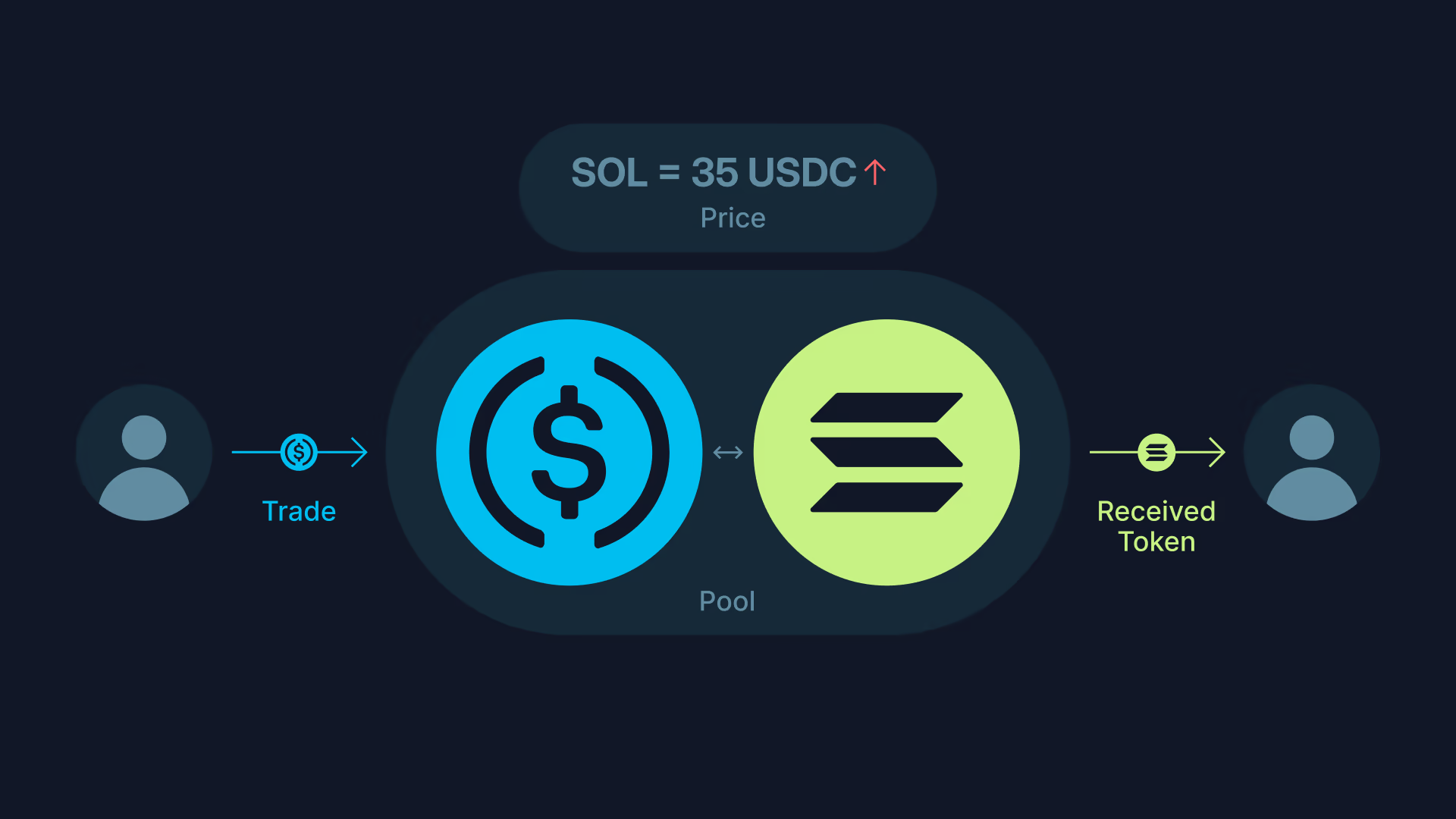
**Automated Market Makers (AMMs)** change this. Instead of waiting for another person, you trade against a "Liquidity Pool" \- a giant pile of money sitting on the blockchain. This means you can trade 24/7, instantly, without needing to find a specific buyer or seller.
### How it Works: The Digital Vending Machine
Think of an AMM like a sophisticated vending machine.
* **The Pool:** The machine is filled with two different items (for example, SOL and USDC).
* **The Trade:** When you want to buy SOL, you put USDC into the machine and take SOL out.
* **The Price:** The machine automatically changes the price based on what is left inside. If a lot of people are buying SOL and the machine is running low, the price of SOL goes up automatically to encourage people to put some back.
Because this is all handled by code ([Smart Contracts](/lessons/smart-contracts)), there is no middleman like a bank taking a cut or closing for the weekend.
### Liquidity Providers: Being the House
The "money in the machine" has to come from somewhere. It comes from users called **Liquidity Providers (LPs)**.
When you become an LP, you are essentially lending your assets to the machine so that others can trade. Most people put in an equal value of two tokens (like $100 of SOL and $100 of USDC). In return, you get a "receipt" called an **LP Token**. This token proves you own a piece of that pool and allows you to withdraw your money whenever you want.
Interested in joining the LP Army? Check out [Meteora.ag](https://www.meteora.ag/).
### How You Earn Money
Why would you let others trade with your money? Because you get paid a fee for every single trade.
* **Trade Fees:** Every time someone makes a swap using the pool you are in, they pay a small fee (usually less than 1%).
* **Earning Your Share:** That fee is split among everyone who provided money to that pool.
* **Passive Income:** On platforms like Jupiter, these fees are often added directly back into your balance. Over time, your "receipt" (LP Token) becomes worth more than what you originally put in.
### The Risks: Price Changes
The biggest risk for an LP is simply the price of the assets changing.
If you put SOL into a pool and the price of SOL crashes or skyrockets compared to the other token in the pool, the "vending machine" will rebalance your holdings. You might end up with more of the token that is worth less.
This is often called **Impermanent Loss**, but the simple version is: if prices move a lot while your money is in the pool, you might have been better off just holding the tokens in your regular wallet.
Successful LPs look for pools with lots of trading volume (more fees) and steady prices, although there are many different techniques for different risk profiles and situations.